At Street Level is a series of posts talking about individual cities unique and often bizarre built environment and what that actually means for the people who live there.
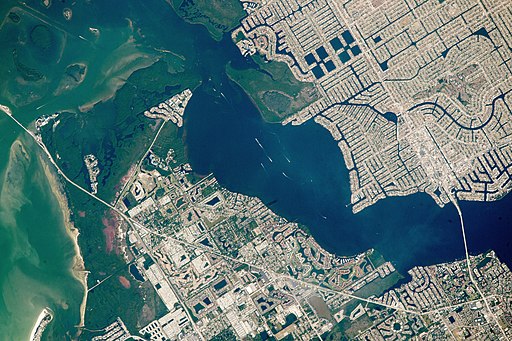
If you’ve ever heard anyone casually bringing up Cape Coral in conversation, you might not find it all that interesting. It’s a smallish city (for Florida), with a good beach climate, that has typical Florida weather, a typical Florida retirement age community, and typical Florida concerns (hurricanes being one of them). However, dig a little deeper, at the street level and you see some bizarre urban planning decisions, which are doing the city no favors when it comes to sustainability.
Cape Coral’s claim to fame, besides the beach, is the huge amount of canals interweaving between every section of the city. Looking at the city from above, its an incredible feat of engineering. Every neighborhood has canals worming their way through and carving out the entire city for miles inland. Some neighborhoods even have a canal between every street,
These canals are completely intentional, as the entire city of Cape Coral is a master planned community. The canals are designed as a major selling point to give the vast majority of residents easy access to some sort of water for boating. The city was developed in the late 50s to be the perfect suburban paradise, where everyone has a house, a backyard with a boat, and most importantly, a personal vehicle. Unfortunately, this suburban mentality has severely impacted the sustainability that Cape Coral can achieve.
At street level, some observations can be made:
1.Cape Coral is pre-planned to be almost entirely suburban, with small strips of land reserved for malls, strip malls, and car-centric shopping from one parking lot to another.
2. The “downtown area” is tiny for a city of Cape Coral’s size (around 180,000), yet its filled with empty parking lots and unused land. There is virtually no urbanity within the city.
3.Because of this pre-planning, the downtown area is boxed in by suburbia, which is almost guaranteed to fight tooth an nail against any expansion of downtown for any reason.
4.Sidewalks are almost non-existent outside of major thoroughfares, and since nearly the entire city is a single-family home suburbia, walking is almost always a difficult, time-consuming process. This makes it largely pointless in the city.
5. The canal system, which is so good for boating, is terrible for connectivity and alternative means of transit. Homes that would take a minute or so to walk between in any other city can easily take 30, 40, 50 minutes to walk in Cape Coral. What’s the point of walking for any reason here? Taking 50 minutes to walk to nowhere in particular isn’t a good use of time.
6.The canals also take up quite a bit of space, making people farther apart from each other.
7. Surprisingly, the city is served by a bus system, but because it only travels down a few major roads(not in neighborhoods for the most part), you’d still might have a 20-30 minute walk both pre and post bus ride.
8. There is a lot of land in every neighborhood that is sitting unused in this city. I believe that because the city is pre-planned suburbia, and under restrictive use-based zoning codes, the organic development of what could be mixed use areas is severely stunted.
9. I would estimate that because of the suburban dominance of the city, the canals that spread neighborhoods apart, and the lack of alternative methods of transit, that the city has a greater issue with traffic than it would have otherwise. The pattern of development within the city not only encourages, but almost mandates the use of a car for your every travel need. I wouldn’t be surprised if the traffic grew worse as the population grew.
Overall impressions: Cape Coral has an enormous amount of wasted potential and wasted space. Because the entire city was pre-planned to a finished state in the 50’s, it lacks in a fundamental aspect of urbanism–flexibility. Cape Coral is severely limited in how it can change and evolve into a form of development that looks different from its 1950’s concept. It’s suburban form is largely resistant to change that can make it more resilient and productive.This city is fragile by design.
Cape Coral hoped to be the perfect dream of 50’s middle America . It probably needs to wake up.
 Planning Blog